
when fear replaces trust
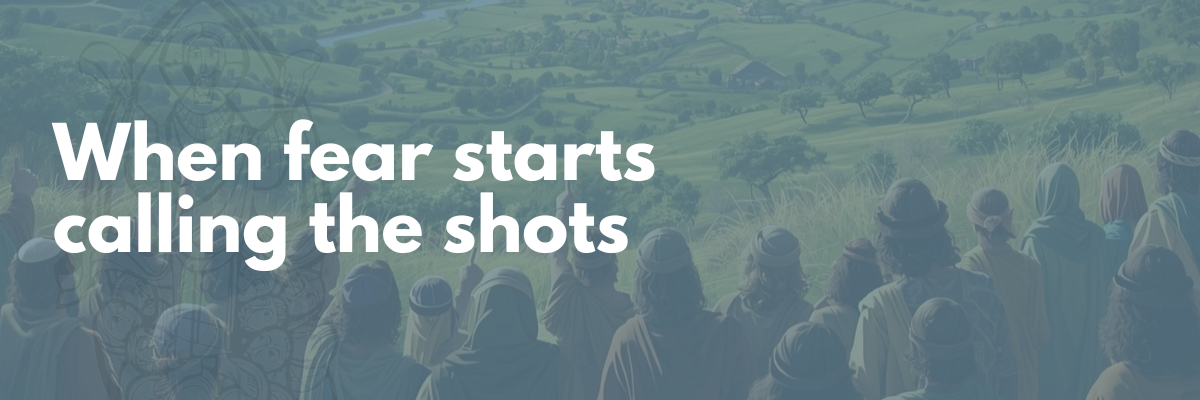
By the time the Israelites stand at the edge of the Promised Land, the evidence should be enough.
They have seen God’s power with their own eyes.
They have been rescued from slavery.
They have been guided, protected, and provided for day after day.
Nothing about this journey suggests God will abandon them now.
And yet, when the moment arrives to move forward, they hesitate.
Not because the promise has changed.
But because fear has entered the conversation.
standing at the edge of promise
In Numbers 13 and 14, leaders are sent into the land God promised to give them. What they find is exactly what God said would be there. The land is rich. The soil is good. The future is full of possibility.
But there is a problem.
The land is already occupied. The cities are fortified. The people living there are strong.
Suddenly, the story shifts. The question is no longer whether God is faithful. It becomes whether the people feel capable.
Fear has a way of doing that.
It narrows our vision. It shortens our memory. It convinces us that past faithfulness has little relevance to present risk.
Instead of asking, “Will God be with us?” the Israelites ask, “What if we fail?”
And fear wins.
As a result, God declares that this generation will not enter the land. Not because He has withdrawn the promise, but because they cannot receive it without trust. A new generation, one shaped more by dependence on God than fear, will be the ones to step forward.
a land meant to reflect something different
When the next generation finally enters Canaan, God’s purpose for the land is clear.
This place is not simply about territory, but the land is more of a testimony.
God intends His people to live in a way that reflects His character. A way that contrasts the destructive practices of surrounding nations. A way that shows what life looks like when trust shapes decisions.
But once again, fear and compromise creep in.
Instead of fully trusting God’s wisdom, the people begin to blend in. Pagan worship slips quietly into everyday life. What was meant to be distinct becomes diluted.
God responds by sending judges and prophets. Leaders who rescue in moments of crisis. Voices who warn when the people drift. Invitations to return.
And a familiar cycle emerges.
The people turn away.
Consequences follow.
They cry out.
God restores.
Over and over again.
This cycle does not reveal a fickle God. It reveals a patient one.
when everyone does what feels right
The book of Judges ends with a sobering observation: “In those days, there was no king in Israel. Everyone did what was right in their own eyes.”
This is not simply a statement about leadership. It is a diagnosis of the human heart.
The absence of a human king is not the real problem. The deeper issue is the rejection of God as king. When trust erodes, people begin to define right and wrong for themselves. When fear dominates, personal judgment replaces shared wisdom. What feels right becomes more compelling than what is right.
Still, instead of returning to God as their king, the Israelites look outward.
They want a king like everyone else has. It’s a painful part of the story to watch unfold.
choosing control over trust
In 1 Samuel 8, the people make their request clear. They want a visible leader. Someone strong. Someone who looks the part.
God warns them what will happen. A human king will take more than he gives. He will demand allegiance. He will disappoint them.
But the people insist. Their request reveals something deeper than a political preference. It exposes a struggle with trust. God grants their request, and Saul becomes king. He is impressive by outward standards. Tall, confident, and commanding. Everything people think leadership should look like.
But Saul’s reign quickly reveals the cost of leadership rooted in fear. He acts impulsively. He struggles to wait. He obeys when it feels safe and resists when it does not.
Eventually, God’s voice grows silent.
Not because God has abandoned His people, but because they have chosen control over trust.
a story that still feels close
This part of the Bible is uncomfortable because it feels familiar.
Fear still pushes us toward control.
Comparison still shapes our decisions.
Trust still feels risky when outcomes are uncertain.
We still reach for what feels safer, more visible, and more predictable than faith. And yet, the story keeps moving forward. Even when His people reject Him as king, God continues to pursue them. He warns. He guides. He restores. He keeps the story moving forward.
This chapter does not resolve the tension between fear and trust. But it helps us see it clearly.
And it prepares us for what comes next.

Paige Peacock Vanosky brings a deeply personal and communal approach to biblical teaching, influenced by her formative years under the mentorship of Dr. Buckner Fanning at Trinity Baptist Church in San Antonio.
Her foundational principle - drawing circles instead of lines - has shaped her ministry and led to the creation of a Bible study that embraces diverse religious perspectives. This study laid the groundwork for The 30-Minute Bible, designed to provide an objective and approachable exploration of the Bible's narratives, making the text accessible to seekers and believers from all walks of life.